Power Steering Pump
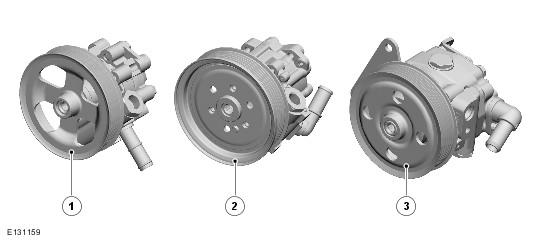
| Item Number | Description |
|---|---|
| 1 | 4.0L V6 |
| 2 | 5.0L V8 |
| 3 | 2.7L, 3.0L TdV6 |
The power steering pumps used on the four engine variants are basically the same pump with different connection fittings. The pump is a positive displacement, vane type pump which supplies hydraulic pressure to the steering gear valve unit. The pump is driven by a Poly Vee belt from the crankshaft pulley and output from the pump increases proportionally with engine speed. A self-adjusting tensioner is fitted to maintain the correct tension on the belt.
The pump has an internal flow control valve which also incorporates a pressure relief valve. The pressure relief valve limits the maximum pressure supplied to the steering gear to 114 bar (1653 lbf in2 ) ± 4 bar (58 lbf in2 ) on V6 petrol engines, and 115 bar (1667 lbf in2 )± 4 bar (58 lbf in2 ) for V8 petrol, and V6 diesel models. The flow control valve regulates the flow to a constant value of 8.8 l/min (1.93 gal/min) ± 0.5 l/min (0.1 gal/min) regardless of engine speed. The pump has a displacement of 9.6 cc/rev (0.58 in3 /rev) on V6 petrol, and V6 diesel, but 11 cc/rev (0.67 in3 /rev) for V8 petrol.
A shaft runs longitudinally through the pump. One end of the shaft is fitted with a pressed-on drive pulley, the opposite end of the shaft is closed by a cover. The shaft runs in bearings located in the body and oil seals at each end of the shaft prevent leakage of hydraulic fluid.
The pump contains ten vanes on petrol models, and eleven vanes on diesel models which rotate within a cam ring and are driven by the shaft. As the vanes rotate, the cam ring causes the space between the vanes to increase. This causes a depression between the vanes and fluid is drawn from the reservoir via the suction hose into the space between the vanes.
As the shaft rotates, the inlet port is closed to the vanes which have drawn in fluid, trapping the fluid between the vanes. The cam ring causes the space between the vanes to reduce and consequentially compresses and pressurizes the hydraulic fluid trapped between them.
Further rotation of the shaft moves the vanes to the outlet port. As the vanes pass the port plate the pressurized fluid passes from the pump outlet port into the pressure hose to the steering gear.
The pressurized fluid is subject to control by the flow control and pressure relief valve. The flow control valve maintains a constant flow of fluid supplied to the steering gear irrespective of engine speed variations. The pressure relief valve limits the pressure on the output side of the pump. A metering orifice is included in the discharge port of the pump. If the pressure in the orifice reaches a predetermined level, a spring loaded ball in the center of the flow control valve is lifted from its seat and allows pressurized fluid to recirculate within the pump.
The pressure relief valve will operate if the discharge from the pump is restricted, i.e.; steering held on full lock. If the output from the pump is blocked, all output is recirculated through the pump. In this condition, as no fresh fluid is drawn into the pump from the reservoir, the fluid temperature inside the pump will increase rapidly. Consequentially, periods of operation of the steering gear on full lock should be kept to a minimum to prevent overheating of the pump and the fluid within it.