Description & Operation: Engine: Crankshaft
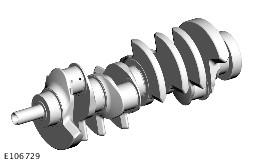
The crankshaft is made from spheroidal graphite cast iron, which, compared with grey cast iron, has higher mechanical strength, ductility and increased shock resistance. The undercut and rolled fillets also improve strength. Eight counter-balance weights ensure low vibration levels and the large, cross-drilled main bearing journals are designed to contribute to stiffness.
An oil groove in the upper half of each main bearing transfers the oil into the crankshaft for lubrication of the connecting rod bearings. A thrust washer is installed each side of the top half of the center main bearing.
Crankshaft Data Location
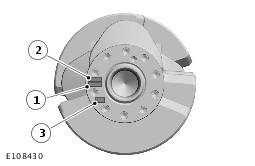
| Item Number | Description |
|---|---|
| 1 | Pin journal classification and plant identification |
| 2 | Main journal classification |
| 3 | Date and time codes |
The main bearings are numbered 1 to 5 starting from the front of the engine. There are five grades of main bearing available, each being color coded. Journal sizes are marked on the rear of the crankshaft. Refer to CRANKSHAFT MAIN BEARING JOURNAL CLEARANCE information.
Crankshaft Installation
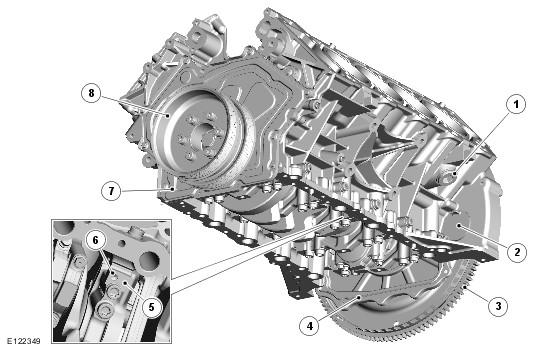
| Item Number | Description |
|---|---|
| 1 | Coolant drain plug |
| 2 | Torque converter access plug |
| 3 | Drive plate |
| 4 | Rear cover |
| 5 | Main bearing cap |
| 6 | Identification mark |
| 7 | Front cover |
| 8 | Front pulley |
The main bearing caps are made from cast iron and are cross bolted to increase rigidity. An identification mark on the bearing cap faces the front of the engine.
At the front of the crankshaft, a tuned torsional vibration damper is incorporated into the crankshaft front pulley. At the rear of the crankshaft a pressed steel drive plate, with a steel starter ring gear, is installed to transfer drive from the engine to the transmission. The reluctor ring for the crankshaft position (CKP) sensor is integrated into the perimeter of the drive plate.
The crankshaft seals are located in the front and rear covers.