Pistons And Connecting Rods
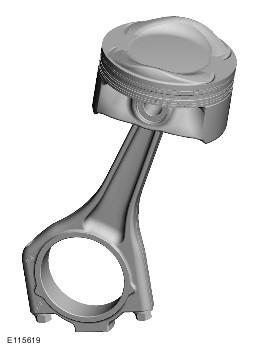
The diameter of each piston is graded and precisely matched to each cylinder bore to help reduce noise. In the vertical plane, the pistons have a slight barrel form, which helps to ensure a reliable oil film is maintained between the piston and the cylinder bore. A solid film lubricant coating is applied to both reaction faces of the piston to reduce wear and improve fuel economy.
A three-ring piston-sealing system is used. The steel top ring is treated with a PVD (physical vapor deposition) peripheral coating. PVD is a coating technique where material can be deposited with improved properties to ensure good cylinder bore compatibility and wear resistance. A Napier center ring helps cylinder pressure and oil management, while the three-piece oil control lower ring is produced from nitrided steel.
The connecting rods are forged from high strength steel. The cap is fracture-split from the rod to ensure precision re-assembly for bearing shell alignment. There are three grades of large end bearing available, each being color coded. Refer to CONNECTING ROD LARGE END BORE information.
Cap Alignment with Connecting Rod
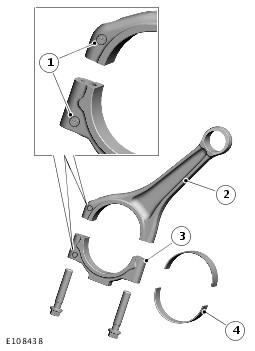
| Item Number | Description |
|---|---|
| 1 | Alignment marks |
| 2 | Connecting rod |
| 3 | Cap |
| 4 | Bearings |
The correct alignment of the cap with the connecting rod is indicated by marks on adjacent faces of the two components.
Connecting Rod and Piston Orientation
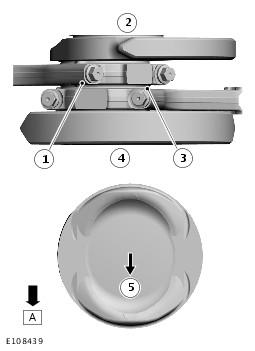
| Item Number | Description |
|---|---|
| A | Front of engine |
| 1 | Alignment mark |
| 2 | LH side (bank B) |
| 3 | Alignment mark |
| 4 | RH side (bank A) |
| 5 | Piston orientation arrow |
The orientation of the connecting rods and pistons on the crankshaft are given below:
- Bank A - The arrow on the piston crown must face the front of the engine and the cap and connecting rod alignment marks must face the rear of the engine.
- Bank B - The arrow on the piston crown must face the front of the engine and the cap and connecting rod alignment marks must face the front of the engine.