Camshaft Profile Switching
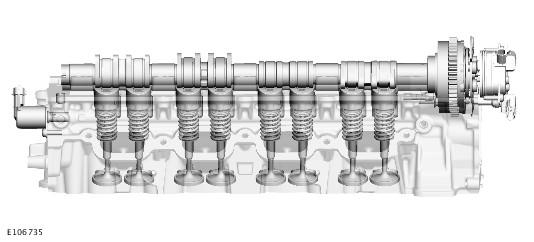
The CPS (camshaft profile switching) system switches the intake valves between two cam profiles which have different lift and period. The low lift profile improves driveability and emissions at lower engine speeds. The high lift profile improves power and torque output at higher engine speeds.
The intake camshafts have three lobes for each valve. The two outer lobes have identical profiles that produce the high lift of 10.53 mm (0.415 in.). The central lobe produces the low lift of 5.50 mm (0.217 in.). Switching between cam profiles is performed by a switchable tappet on each intake valve. The switchable tappets are operated by engine oil controlled by a CPS solenoid on each cylinder head. Operation of the CPS solenoids is controlled by the engine control module (ECM).
Camshaft Profile Switching Solenoids
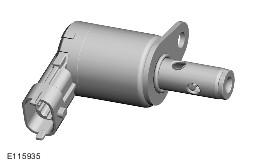
The CPS solenoids control the supply of engine oil pressure to the locking pins in the switchable tappets, to switch the tappets between the two cam profiles.
A CPS solenoid is installed on the rear of each cylinder block. Each CPS solenoid has a pintle installed in a sleeve, which incorporates oil inlet and outlet holes. The sleeve is installed at the junction of oil galleries in the cylinder head, with the oil inlet and outlet holes aligned with the galleries. Movement of the pintle in the sleeve controls a connection between the oil galleries. When the CPS solenoid is energized, the pintle connects an oil supply gallery to the gallery along the outboard side of the switchable tappets. When the CPS solenoid is de-energized, the oil gallery along the outboard side of the switchable tappets is connected to drain.
The CPS solenoids receive a fused battery supply from the main relay. The engine control module (ECM) switches a ground connection to operate the solenoids.
Switchable Tappets
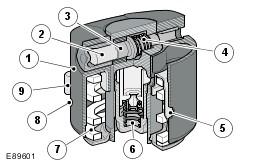
| Item Number | Description |
|---|---|
| 1 | Outer tappet |
| 2 | Outer locking pin |
| 3 | Inner locking pin |
| 4 | Return spring |
| 5 | Lash adjuster oil inlet |
| 6 | Lash adjuster |
| 7 | Lost motion spring |
| 8 | CPS oil inlet |
| 9 | Anti-rotation lug |
The switchable tappets are installed on the intake valves, in bores in the cylinder heads. The cylinder heads incorporate engine oil galleries along the inboard and outboard sides of the bores. The inboard oil galleries (between the tappets and the spark plug/fuel injector bores) supply an oil feed to the locking pins in the switchable tappets. The outboard oil galleries (over the inlet ports) supply an oil feed to the hydraulic lash adjusters in the switchable tappets.
Each switchable tappet consists of inner and outer tappets, which can operate independently or be locked together by locking pins. A hydraulic lash adjuster on the bottom of the inner tappet locates on the intake valve stem.
In low lift, the intake valve lift is controlled by the inner tappets, which run on the center lobes of the intake camshafts. The outer tappets run on the outer lobes of the intake camshafts, and move up and down the inner tappets without affecting the valve lift. The lost motion springs keep the outer tappets in contact with the outer lobes. Movement of the inner tappets is transferred to the intake valves through the hydraulic lash adjusters.
In high lift, engine oil is supplied to the locking pins, which lock the outer tappets to the inner tappets. Intake valve lift is controlled by the outer tappets, which run on the outer lobes of the intake camshafts. Movement of the outer tappets is transferred to the intake valves through the locking pins, the inner tappets and the hydraulic lash adjusters.
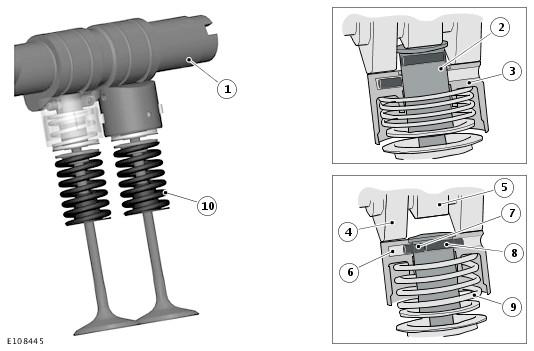
| Item Number | Description |
|---|---|
| 1 | Intake camshaft |
| 2 | Inner tappet |
| 3 | Outer tappet |
| 4 | Outer cam profile (high lift) |
| 5 | Inner cam profile (low lift) |
| 6 | Locking pin oil pressure inlet |
| 7 | Outer locking pin |
| 8 | Inner locking pin |
| 9 | Outer tappet lost motion spring |
| 10 | Valve spring |
Camshaft Profile Switching Operation
The switching point is speed and load dependent. This strategy ensures that switching occurs at air flow neutral points in the engine's operation and is imperceptible to the driver.
At engine speeds from idle up to the range of 2825 - 4250 rev/min (depending on engine load), the CPS solenoids are de-energized and the switchable tappets are set to low lift. At engine speeds above the 2825 - 4250 rev/min range, the CPS solenoids are energized by the engine control module (ECM) and the switchable tappets are set to high lift. There is a 200 rev/min hysteresis when switching from high lift to low lift with decreasing engine speed. Switching between lift settings occurs within one revolution of the camshaft.
Switching is only enabled at engine oil temperatures of 20 °C (68 °F) and above. At oil temperatures below 20 °C (68 °F), CPS operation is disabled and the switchable tappets remain in the low lift setting. CPS operation is also disabled if a CPS solenoid fails. When CPS operation is disabled, engine speed is limited to 5000 rev/min.
The engine control module (ECM) can diagnose the operation of the CPS solenoids and store fault related diagnostic trouble code (DTC) if it detects a failure.