Heated Oxygen Sensors
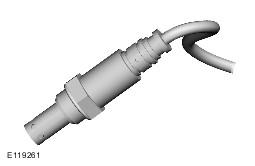
The heated oxygen sensors allow the engine control module (ECM) to measure the oxygen content of the exhaust gases, for closed loop control of the fuel:air mixture and for catalytic converter monitoring.
An upstream heated oxygen sensor is installed in the outlet of each exhaust manifold, which enables independent control of the fuel:air mixture for each cylinder bank. A downstream heated oxygen sensor is installed in each catalytic converter, which enables the performance of the catalytic converters to be optimized and monitored.
Oxygen sensors need to operate at high temperatures in order to function correctly. To achieve the high temperatures required, the sensors are fitted with heater elements that are controlled by a pulse width modulation (PWM) signal from the engine control module (ECM). The heater elements are operated after each engine start, once it has been calculated that there is no moisture in the exhaust (between 0 and 2 minutes delay), and also during low load conditions when the temperature of the exhaust gases is insufficient to maintain the required sensor temperature. The pulse width modulation (PWM) duty cycle is carefully controlled to prevent thermal shock to cold sensors. A non-functioning heater delays the sensor's readiness for closed loop control and increases emissions.
The upstream heated oxygen sensors produce a constant voltage, with a variable current that is proportional to the lambda ratio. The downstream heated oxygen sensors produce an output voltage dependant on the ratio of the exhaust gas oxygen to the ambient oxygen.
The heated oxygen sensors age with mileage, increasing their response time to switch from rich to lean and lean to rich. This increase in response time influences the engine control module (ECM) closed loop control and leads to progressively increased emissions. Measuring the period of rich to lean and lean to rich switching monitors the response rate of the upstream sensors.
Diagnosis of electrical faults is continually monitored in both the upstream and downstream sensors. This is achieved by checking the signal against maximum and minimum threshold, for open and short circuit conditions.
If a heated oxygen sensor fails:
- The engine control module (ECM) defaults to open loop fueling for the related cylinder bank
- The CO (carbon monoxide) and emissions content of the exhaust gases may increase
- The exhaust may smell of rotten eggs (hydrogen sulphide).
With a failed heated oxygen sensor, the engine will suffer from reduced refinement and performance.