Electronic Throttle
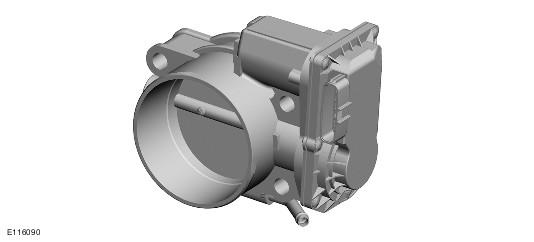
The engine control module (ECM) uses the electronic throttle to help regulate engine torque.
The electronic throttle is attached to the intake manifold. Refer to Intake Air Distribution and Filtering .
The throttle plate is operated by an electric DC (direct current) motor integrated into the throttle body. The engine control module (ECM) uses a pulse width modulation (PWM) signal to control the DC motor. The engine control module (ECM) compares the accelerator pedal position (APP) sensor inputs against an electronic request or value to determine the required position of the throttle plate. The engine control module (ECM) and electronic throttle are also required to:
- Monitor requests for cruise control operation
- Automatically operate the electronic throttle for accurate cruise control
- Perform all dynamic stability control engine interventions
- Monitor and carry out maximum engine speed and road speed cut outs
- Provide different engine maps for the ride and handling optimization system.
A software strategy within the engine control module (ECM) calibrates the position of the throttle plate at the beginning of each ignition cycle. When the ignition is turned on, the engine control module (ECM) performs a self test and calibration routine by fully closing the throttle plate and then opening it again. This tests the default position springs and allows the engine control module (ECM) to learn the fully closed position.