Tire Pressure Monitoring System (TPMS): Notes
Tire Pressure Monitoring System - Component Location
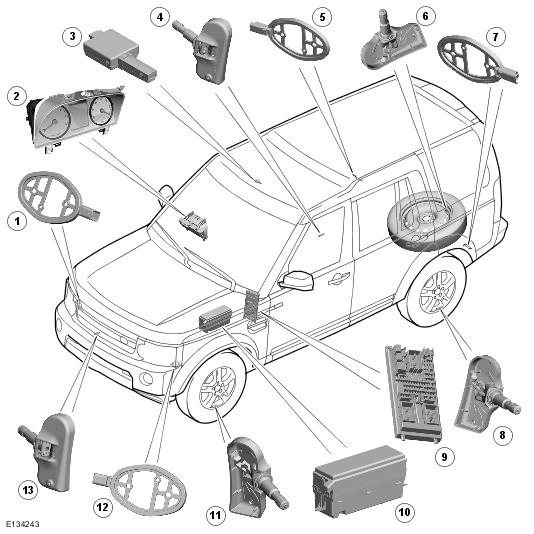
| Item Number | Description |
|---|---|
| 1 | RH (right-hand) front initiator |
| 2 | Instrument cluster |
| 3 | TPMS RF receiver |
| 4 | RH rear tire pressure sensor |
| 5 | RH rear initiator |
| 6 | Spare tire pressure sensor |
| 7 | LH rear initiator |
| 8 | LH rear tire pressure sensor |
| 9 | CJB (central junction box) |
| 10 | EJB (engine junction box) |
| 11 | LH front tire pressure sensor |
| 12 | LH front initiator |
| 13 | RH front tire pressure sensor |
The purpose of the Tire Pressure Monitoring System (TPMS) is to assist the driver in maintaining the vehicle's tire pressures at the optimum level in order to:
- Improve fuel consumption
- Maintain ride and handling characteristics
- Reduce the risk of rapid tire deflation - which may be caused by under inflated tires
- Comply with legislation in relevant markets.
The TPMS measures the pressure in each of the tires on the vehicle (including the spare, if required) and issues warnings to the driver if any of the pressures deviate from defined tolerances.
NOTE:
During a 'blow out' a very rapid reduction in pressure is experienced. The system is not intended to warn the driver of a 'blow out', since it is not possible to give the driver sufficient warning that such an event is occurring, due to its short duration. The design of the TPMS is to assist the driver in keeping the tires at the correct pressure, which will tend to reduce the likelihood of a tire 'blow out' occurring.
NOTE:
TPMS is inhibited when the vehicle is in Delivery mode. For more details on Delivery mode refer to the PDI manual.
A single TPMS hardware configuration is used. TPMS status information is relayed to the driver with a message displayed in the instrument cluster message center and a amber warning indicator.