Tire Pressure Sensor
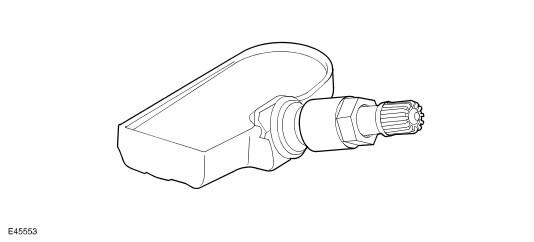
The TPMS system uses 'active' tire pressure sensors which are mounted on each wheel, inside the tire cavity. The sensor is retained in position by the valve attachment to the wheel structure. The sensors transmit their RF signals at either 315 MHz or 433 MHz dependent on market requirements.
The sensors periodically measure the pressure and temperature of the air inside the tire plus the centripetal acceleration acting on the sensor. These measurements are transmitted periodically to the RF receiver located behind the overhead console.
The tire pressure sensors are self-contained units which have no electrical connections into or out of the sensor.
The care points detailed in the 'Tires' section of this chapter must be followed to avoid damage to the sensor. If the sensor is replaced, the nut, seal and washer must also be replaced and the sensor tightened to the correct torque value as given in the Service Repair manual.
The RF transmission from the sensor contains a unique identification code in its transmission data, so that the central junction box (CJB) can identify the tire on the vehicle. If the sensor is replaced on a 'running' wheel, the new sensor identification will be learnt when the vehicle is first driven at a speed of more than 12.5 mph (20 km/h) for 15 minutes. If a new sensor is fitted to the spare wheel, the identification for that sensor must be programmed into the central junction box (CJB) using a Land Rover approved diagnostic system or that wheel will not be monitored. The code is provided on a label with the complete wheel and tire assembly when new and is also printed on the casing of each sensor.
The replacement spare wheel may also be programmed to the vehicle by using it as a 'running' wheel for 15 minutes at more than 12.5 mph (20 km/h), then replacing it to the spare wheel position.
In order to conserve battery power, the tire sensor module uses different transmission rates when the wheel is stationary or moving. The wheel speed required to change between the stationary and moving transmission rates is very low to allow for the requirement for slow off-road driving.