TDV6 Coolant Pump Leaks (SSM51257)
Reference number: SSM51257
TDV6 COOLANT PUMP LEAKS
TECHNICAL SERVICE BULLETIN
| LAND ROVER: | LR3/L319, LR4/L319, Range Rover/L322, Range Rover Sport/L320 |
| CATEGORY: | Engine |
SERVICE INFORMATION
Symptom 402000 Cooling System Concerns
Attachments 12.7 & 3.0 TDV6 Coolant pump.pdf (12.7 & 3.0 TDV6 Coolant pump.pdf)
ISSUE
Content
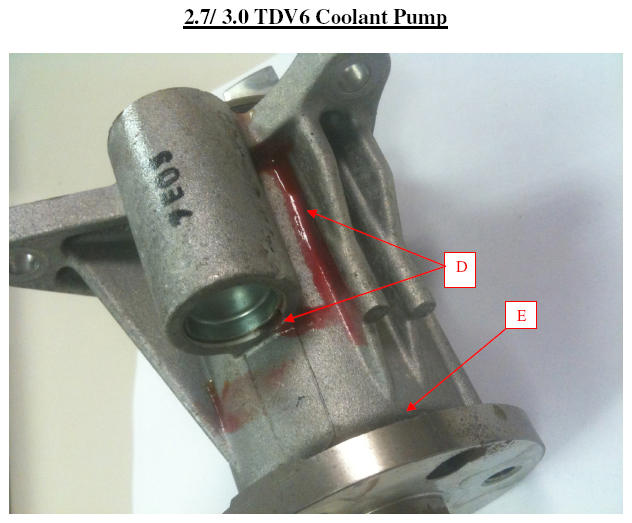
Warranty returned coolant pumps have been tested. The pumps work correctly, with no evidence of coolant leaks. Some coolant staining can be seen (see attached file for examples of the staining).
CAUSE
It is common for a visible sign of coolant staining around the Core plug and Ventilation holes (D) (please view attachment '2.7&3.0 Litre TDV6 Coolant Pump'), however this is not a cause for concern and coolant pump replacement is not necessary. The staining is as a result of the position of the evaporation hole and is not a sign of abnormal coolant loss.
ACTION
The coolant pump should only be replaced where there is coolant leakage from the end shaft seal (E) or signs of free-play/excessive noise/binding in the bearing. Follow the process below to determine if the coolant pump needs replacing due to a leak.
- Clean the area around the coolant pump and the pump housing.
- Check the coolant level and top up if required.
- During these tests the coolant level should not be allowed to drop below the 'Cold Fill Range' lower level mark. It may be necessary for a second person to monitor the coolant level.
- NOTE: When the cooling system is warm, the coolant will be approximately 10mm above the upper level mark on the expansion tank with the cap removed.
- IMPORTANT: If there are any signs of engine running issues, or a significant coolant loss, stop these tests immediately.
- Set the heater controls to maximum.
- Start the engine. With vehicle in park increase engine speed to 1500 rpm.
- Check the front heater is warm (after approximately 2 minutes)
- Switch the heater off.
- Raise the engine speed to 2000 RPM and hold for 8 minutes.
- Switch the engine off and allow to cool
- Visually check the engine coolant pump system for a coolant leak.
- Only replace the pump if a coolant leak from the pump is confirmed