Hydraulic Power Steering System Diagnosis (LTB00704NAS1)
WARNING: This page is about the LR4 Base, which is a different variant/trim than selected.
Publication date: 2015-01-05Reference number: LTB00704NAS1
HYDRAULIC POWER STEERING SYSTEM DIAGNOSIS
TECHNICAL SERVICE BULLETIN
Reference Number(s): LTB00704NAS1, Date of Issue:
January 5, 2015
| LAND ROVER: | 2008-2009 LR3 (LA); 2010 Onwards LR4 (LA); 2008-2015 LR2 (LF); 2008-2013 Range Rover Sport (LS); 2008-2012 Range Rover (LM) |
| SECTION: | 211-02 |
| AFFECTED VEHICLES: | LR3 (LA) Model Year: 2008-2009 VIN: 8A442165-9A513325; LR4 (LA) Model Year: 2010 Onwards VIN: AA513326 Onwards; LR2 (LF) Model Year: 2008-2015 VIN: 8H000212-FH439912; Range Rover Sport (LS) Model Year: 2008-2013 VIN: 8A119897-DA814822; Range Rover (LM) Model Year: 2008-2012 VIN: 8A271091-CA393639 |
CONDITION SUMMARY
Situation: This is an information only bulletin to aid in the diagnosis of Hydraulic Power Steering issues.
Action: When diagnosing customer concerns relating to the Hydraulic Power Steering system, refer to the SERVICE INFORMATION below.
PARTS
NOTE:
For all vehicle lines, inner tie-rods, boots, clips and outer joints are now all available separately as service parts. Review the parts catalogue accordingly.
No Parts Required
TOOLS
No Tools Required
SERVICE INFORMATION
Below are highlighted some of the most prevalent common poor practices
NOTE:
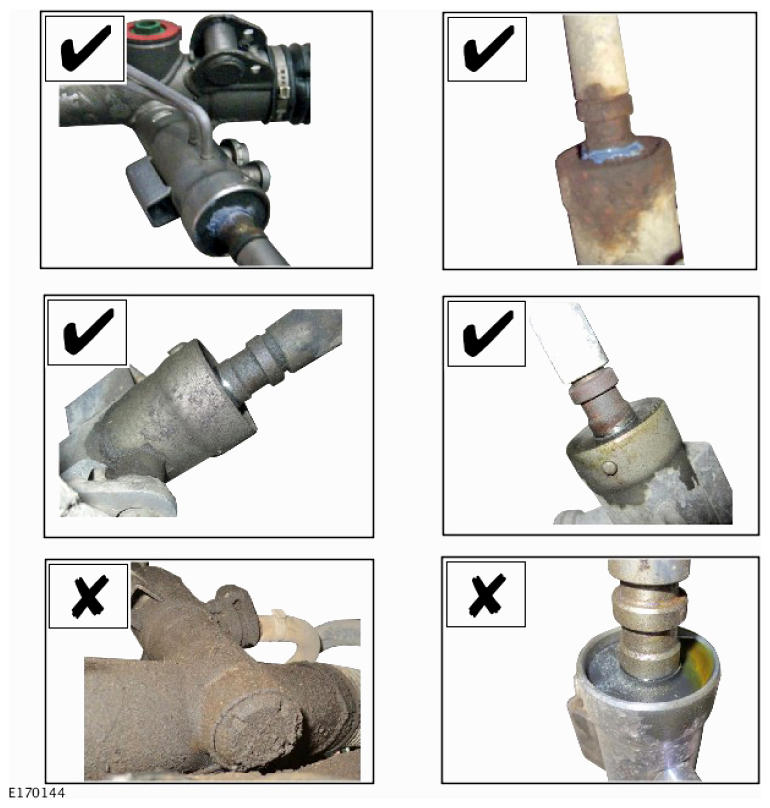
misting/dampness around the input shaft seal can be mis-diagnosed as leaks (see top four pictures with '√'); this is normal. Suspected leaks ('x') should always be verified by cleaning and chalking.
- Fluid Misting/Dampness Around Pinions and Bellows
- 'Misting' or a damp area may be commonly seen around the steering gear pinion tower seal and the steering gear bellows. This is normal and occurs on most hydraulic dynamic seals due to their design and is not a reason to change the steering gear, nor does it indicate the part will fail early or later in life. If there is a suspicion of a leak, then normal procedures using cleaning and chalk should be employed.
- 'Misting' or a damp area may be commonly seen around the steering gear pinion tower seal and the steering gear bellows. This is normal and occurs on most hydraulic dynamic seals due to their design and is not a reason to change the steering gear, nor does it indicate the part will fail early or later in life. If there is a suspicion of a leak, then normal procedures using cleaning and chalk should be employed.
- Joint 'Dnocks': Mis-diagnosis
- A considerable number of steering gears are unnecessarily changed due to mis-diagnosis of play in joints. It is very uncommon to cause play in gears (can be created from hard accidents), but joint play is regularly mis-diagnosed as steering gear backlash rather than play in ball joint or column joints. Carefully following Diagnostics and Testing (see TOPIx Workshop Manual, section 211-02) for the steering linkage will help isolate the failed component.
- Pump Failure: Mis-diagnosis
- A considerable number of steering gears are unnecessarily changed due to pump damage leading to blanket repairs. The most common reason for steering system noise is damaged pumps. In most cases this is caused by system leaks (low fluid leading to cavitation), grit contamination during top-ups, or holding the steering on full lock too long. In these cases, it is critical to make sure there are no leaks in the system that may cause further failures. However, the majority of these issues can be diagnosed using Diagnostics and Testing (see TOPIx Workshop Manual, section 211-02) for pressure testing and if required flushing the system and changing the pump.
- Bellows - Holes
- If a steering gear fails - particularly with rust and grit found inside the bellows - it is important the bellows are carefully checked for holes and perforations. Steering gears are not warranted for this type of failure.
- Bellows - Incorrect Use of Cable Ties
- Commonly, after joints have been inspected cable ties are used to try and re-seal the boots. This is ineffective and normally leads to further steering gear failures. All clips are available as lower level service parts and should be used after removal of a boot.
- Incorrect Level of Repair
- Often incorrect levels of repair are made on steering gears. The parts catalog should be inspected to identify what is available along with correct level of diagnosis. Commonly missed parts that may be used are, transfer pipes, feed & return pipe o-rings and inner ball joints.