High Beam Assist Operation
The high beam assist operates as part of the automatic headlight system. When driving at night with the lighting control switch in the automatic position and the LH steering column multifunction switch in the central position, with sufficient darkness (approximately 1 lux or less) and a suitable road speed, the high beam assist will automatically operate the high beam lighting when necessary. A warning symbol in the instrument cluster confirms to the driver when the high beam assist system is selected and enabled.
Activation (system ready)
High beam assist will only activate and illuminate the warning indicator to show system is ready or 'primed' for high beam control, when the following conditions are met:
- High beam assist has been first 'enabled' via the instrument cluster menu
- Lighting control switch is in the 'Auto' position
- LH steering column multifunction switch in the central position
- The ambient light level is below 100 lux - refer to 'Light Levels' section that follows
- The system has not been overridden or cancelled - refer to 'Override' section that follows
- The camera (image) sensor view is not blocked.
High Beam Control
When activated, high beam assist will switch the headlamps to high beam when all the following conditions occur:
- No relevant oncoming traffic
- No relevant preceding traffic
- In non-urban environment, i.e. with no street lighting
- Ambient light level is below 1 lux - refer to 'Light Levels' section that follows
- Road speed is suitable - refer to 'Road Speed' section that follows.
Low Beam Control
When activated, high beam assist will switch the headlamps to low beam when any of the following conditions occur:
- Relevant Oncoming traffic is present
- Relevant Preceding traffic is present
- In urban environment, i.e. with street lighting
- Ambient light level is above 1 lux - refer to 'Light Levels' section that follows
- Road speed is not suitable - refer to 'Road Speed' section that follows
- Unrecognizable reflective inputs from road signs or markings - refer to 'System Limitations' section that follows.
Light Levels
The exterior lighting 'on' threshold for the normal 'auto headlamps' feature is approximately 100 lux and is measured by the windscreen mounted 'rain/light' sensor. When the light level falls to this value the low beam headlamps and exterior lights will be switched on together with the high beam assist warning indicator.
This warns the driver that the system is activated and ready to automatically switch on the high beam headlamps when the light level falls a little further to approximately 1 lux, as measured by the 'ambient light sensor' located in the mirror body. High beam is generally not required with light levels above 1 lux.
Road Speed
A road speed signal is received by the CJB from the Anti-lock Braking System (ABS) module via the high speed CAN bus. When the other activation conditions are correct, the CJB will switch the headlamps to high beam when the road speed has increased above 40 km/h (25 mph).
When the road speed falls to below 24 km/h (15mph), the CJB will switch the headlamps to low beam. The 10 mph (15 km/h) difference between the on and off road speed thresholds prevents the system continually switching between high and low beam at low speeds.
Override
The driver can manually override the high beam assist system at any time. When the high beam assist system is activated, pulling the LH steering column multifunction switch to the high beam 'flash' position or pushing it forward to the high beam position will de-activate the system and the high beam assist warning indicator in the instrument cluster will extinguish.
When the multifunction switch is returned to the central position, from a forward high beam position, the system is re-activated and the high beam assist warning indicator will illuminate again.
Correct Performance
In addition, high beam assist will only exhibit best performance if all of the following conditions are met:
- No false inputs are received by the camera (image) sensor, such as reflected light from certain static signs - refer to 'System Limitations' section that follows
- Headlamps are correctly aligned
- High beam assist system has been set for correct 'hand of traffic' via the driver menu settings - refer to 'Setting Hand of Traffic' section that follows
- Headlamps have been set for correct 'hand of traffic' via the mechanical tourist lever in headlamp casing - refer to 'Setting Hand of Traffic' section that follows
- Camera (image) sensor has been through a self learning 'auto aim' calibration procedure if any components have been replaced - refer to 'Calibration' section that follows
- There are no large reflective items, white papers, etc., sitting on top of the dash board in near view of the camera (image) sensor, or stickers placed directly in front of the camera (image) sensor
Driver Menu Features
The high beam assist feature must first be enabled using the configuration menu available in the instrument cluster. However if required, the high beam assist system can be permanently disabled leaving the basic 'Auto Lamps' system still operative.
Within this menu the system can also be configured for driving on the alternate side of the road (Hand of Traffic). This enables the system to be used in different regions and it's setting is important for correct operation.
Setting 'Hand of Traffic' and High Beam Assist 'Enable'
To set the high beam assist options the following steps must be sequenced:
- With the ignition in power mode 6 (ignition on), and the engine not running, use the controls on the steering wheel to select on the instrument cluster menu:
Menu > Vehicle Set-up > High Beam Assist
- Configure the 'Hand of Traffic' setting by selecting the appropriate 'Drive on Left' (of road) or 'Drive on Right' (of road) to the applicable Market condition
- Enable the feature by setting 'Activate Assist' if not already selected.
The instrument cluster menu also includes a 'High Beam Assist Sensitivity' selection. This is a requirement option for NAS market vehicles only but it is not recommended for normal use and has been superseded.
Refer to Instrument Cluster .
System Limitations
The high beam assist system can occasionally have difficulty distinguishing between light from other vehicles or reflected light from static highly reflective road signs.
These situations may cause the high beam assist system to undesirably operate the high beam headlamps or take no action at all. Examples of these situations are as follows:
- Dips, hollows or crests in the road
- Highly reflective static Road signs
- Tight bends
- Poorly illuminated vehicles e.g. cyclists or small mopeds
- Motorway central barriers
- Extreme weather conditions e.g. Fog, heavy snow
- Exterior domestic or industrial lighting
Reflective Static Signs
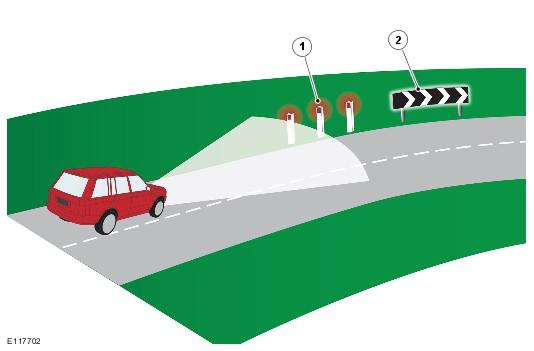
| Item Number | Description |
|---|---|
| 1 | Red reflective signs could be detected as rear tail lamps |
| 2 | Large reflective signs could affect the system |
Manual Deactivation
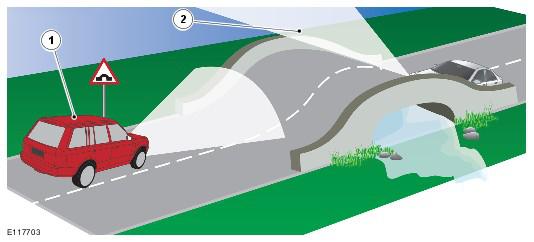
| Item Number | Description |
|---|---|
| 1 | Vehicle equipped with high beam assist |
| 2 | Oncoming vehicle headlamps can be seen by the driver before the high beam assist image sensor detects the oncoming light input |
There are situations when a driver is able to judge if a high beam deactivation is desirable before the high beam assist system actually operates, for example over a crest of a hill. Headlamps from an oncoming vehicle can sometimes be seen on the horizon prior to the detection sensor receiving an input. It is the driver's preference to determine if early intervention is desired in this and similar situations.
System Diagnosis
High beam assist has a self diagnosis capability by comparing data from the ambient light sensor input (located in the rear view mirror) to light levels detected by the image sensor. If a deviation is detected it is assumed that the ambient light available to the image sensor is being restricted by dirt or other blockage and the system will be deactivated. Diagnostic Trouble Code (DTC)'s are stored in the control module's memory and can be accessed using an approved Land Rover diagnostic system. Within the diagnostic system is a procedure to test the basic operation of the camera function.
In the event of a fault, the warning strategy to the driver is as follows:
- Image sensor internal fault - green icon will extinguish with no additional message to driver
- CJB has lost all communication with image sensor - green icon will extinguish with no additional message to driver
- Image sensor blocked - green icon will extinguish with an additional "High Beam Assist Sensor Blocked" message within the message center
System Calibration
To achieve effective operation of the high beam assist system, a calibration routine is performed on vehicle build and system tolerances are set to an accuracy of +/- 0.2 degrees.
This initial calibration is a 'one time only' procedure. Should the high beam assist components or the windshield require replacement at the dealership, an automatic calibration routine will be performed. This 'auto aim' calibration procedure is a continual process that takes place during a normal drive cycle at night and could take between 10 - 30 minutes dependant on the following driving conditions:
- If sufficient road markings (lane markings) are visible to the image sensor - approximately 10 minutes
- If insufficient road markings are visible, the system uses the tail lights of preceding vehicles - approximately 30 minutes.