Electronic Rear Differential Assembly: Notes
Electronic Rear Differential - Exploded View
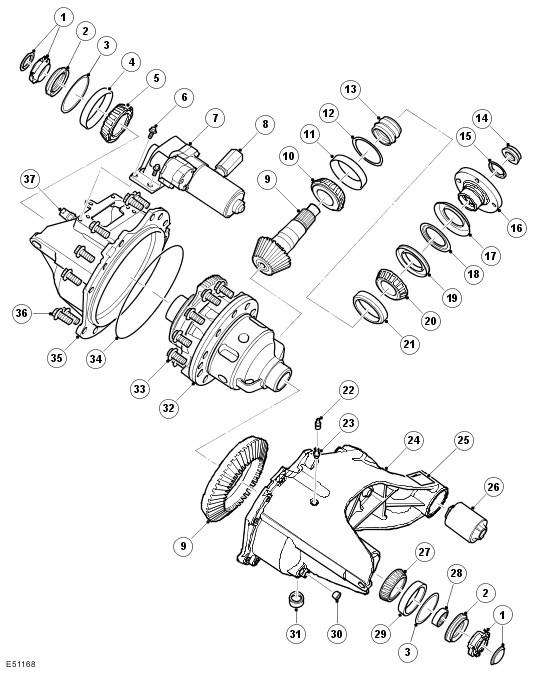
| Item Number | Description |
|---|---|
| 1 | Cap |
| 2 | O ring |
| 3 | Bearing pre-load spacer |
| 4 | Bearing |
| 5 | Bearing cup |
| 6 | Bolt, 4 of |
| 7 | Housing and motor assembly |
| 8 | Damper |
| 9 | Gear and pinion assembly |
| 10 | Bearing |
| 11 | Bearing cup |
| 12 | Shim |
| 13 | Collapsible spacer |
| 14 | Pinion nut |
| 15 | Retainer |
| 16 | Flange |
| 17 | Deflector, outer |
| 18 | Deflector, inner |
| 19 | Seal |
| 20 | Bearing |
| 21 | Bearing cup |
| 22 | Breather cap |
| 23 | Breather |
| 24 | Case |
| 25 | Data location |
| 26 | Mounting bush |
| 27 | Bearing |
| 28 | Bearing assembly without race |
| 29 | Bearing cup |
| 30 | Filler plug |
| 31 | Drain plug |
| 32 | Electronic differential assembly |
| 33 | Bolt, 10 of |
| 34 | O ring |
| 35 | Cover |
| 36 | Bolt, 12 of |
| 37 | Temperature sensor |
The electronic rear differential has the same functionality as the open rear differential but incorporates a locking feature.
An electronically controlled multi-plate clutch provides a rear differential lock and torque biasing function to give improved traction performance and vehicle dynamic stability.
A strategy, to electronically control the rear differential multi-plate clutch assembly, has been developed to provide:
- A pre-loading function, increasing locking torque with increased driving torque
- A slip controller to increase locking torque under off-road conditions and decrease locking torque for optimum comfort, e.g. parking.
The unit receives a torque input from the transfer box output shaft, which is passed through the unit to two outputs for the rear drive halfshafts.
The unit detects wheel slip via various vehicle system inputs to the electronic rear differential control module and locks the differential accordingly.
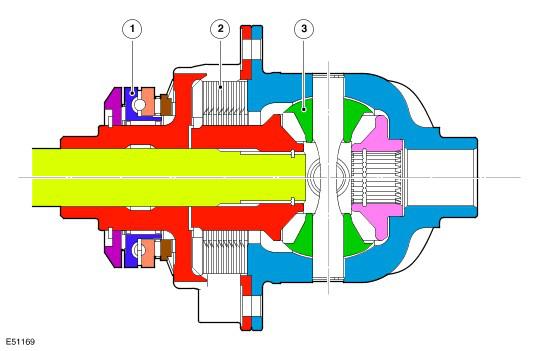
| Item Number | Description |
|---|---|
| 1 | Actuator |
| 2 | Clutch pack |
| 3 | Differential |
The electronic rear differential locking and biasing feature is actuated via a DC motor, which is controlled by the electronic rear differential control module, via a Pulse Width Modulation (PWM) signal.