Multi-plate Clutch Assembly
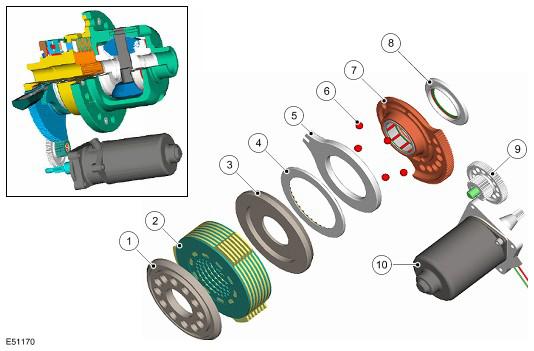
| Item Number | Description |
|---|---|
| 1 | Pressure disc |
| 2 | Clutch plate assembly |
| 3 | Pressure disc |
| 4 | Thrust race |
| 5 | Output actuator |
| 6 | Actuator balls |
| 7 | Input actuator |
| 8 | Bearing pre-load spacer |
| 9 | Reduction gearset |
| 10 | Actuator motor |
The multi-plate clutch assembly for both center (transfer box) and electronic rear differentials act in a similar way. The aim of the multi-plate clutch assembly is to prevent excessive differential slip and therefore maximize the traction performance of the vehicle. This is fundamentally different from the 'braked' traction control, which can only counter act differential slip when it occurs.
A certain amount of differential slip is required to allow the vehicle to turn corners and to remain stable under control of the Anti-lock Braking System (ABS). The transfer box control module monitors the driver's demands through primary vehicle controls and automatically sets the slip torque at the rear differential via the electronic rear differential control module. The system is completely automatic and does not require any special driver input.
The multi-plate clutch assembly actively controls the torque flow through the rear differential and optimizes the torque distribution in the driveline. The clutch assembly biases the torque from the differential to the wheels with the higher grip and prevents the wheels with the lower grip from spinning.
By turning the input actuator disc, via the motor shaft, the output actuator is rotated. This movement acts on 5 balls in a ramp mechanism between the input and output actuators and gives a defined axial movement. The movement forces the pressure disc to induce friction between the sun gear and differential case via the clutch plates supported by the sun gear and the plates supported by the clutch basket on the differential case. This frictional force inhibits the differential rotation; the differential case and left hand differential side gear are locked together.