System Description
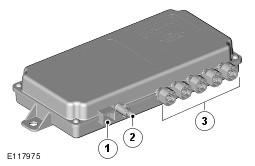
| Item Number | Description |
|---|---|
| 1 | Power supply, ground and BUS connector |
| 2 | Connection to touch screen display |
| 3 | Five camera connections |
The proximity camera control module is located under the left-hand-front seat; connections to the module include:
- Medium speed CAN network
- Five camera inputs
- Video signal output to the TSD
- Power supply and ground.
The control module gathers the camera images and analyses and alters them by adjusting perspectives and applying corrections. The resulting processed images are then relayed to the touch screen display via the NTSC (National Television System Committee) analogue video line.
The control module also adds guidance and warning overlays to the camera images to create the various driving-aid features supported by the camera proximity system; for example, visual direction is made available when reversing the vehicle.
The module communicates with each individual camera via the LIN (local interconnect network) bus connection. This data link transmits diagnostic information, for example camera serial numbers and fault notifications to the control module. Camera adjustments, for instance a correction to color-balance are also communicated via the LIN bus link to the camera.
Cameras
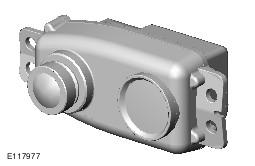
The system uses five VGA resolution cameras, permanently powered whenever the ignition is 'on'. Each camera provides an image covering a zone approximately 130° wide by 112° deep and is capable of capturing approximately thirty frames per second.
The cameras employ high-quality digital, HDR (High Dynamic Range) imaging, which is a set of techniques that allows a greater range of luminance between light and dark areas of an image scene. This allows HDR to more accurately represent the varying intensity levels found in the image scenes that can range from direct sunlight to deep shadows.
Front Camera mounting
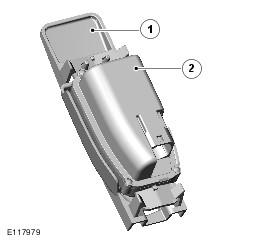
| Item Number | Description |
|---|---|
| 1 | Camera 'break free' bracket |
| 2 | Camera |
To reduce the cost of accident repair the mounting of the front bumper cameras feature a 'snap free' bracket. On impact, the bracket will release the camera preventing damage to the camera itself. Depending on the severity of the accident it may also be possible to reuse the brackets as they are manufactured from a memory type plastic.
The front cameras are not 'handed' so therefore interchangeable. This is also applicable for the door-mirror cameras, although these cameras do feature the approach lighting LED integral within the camera body.
The positioning accuracy of all the cameras is crucial for the successful operation of the proximity camera system. The camera housings are manufactured using metal to maintain a structural stability in high-ambient temperatures. Without this stability a loss of image focus would be a possibility, therefore care must be taken when mounting the cameras in ensuring they sit correctly into their locations. Secure mounting of the cameras provides an initial 'build up' tolerance accurate to 2mm. In the event of camera replacement a calibration routine must be performed.