Impact Sensors
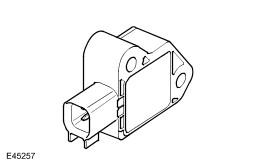
Impact sensors are installed in the front and both sides of the vehicle. The use of multiple impact sensors provides shorter air bag trigger times, through faster detection of lateral and longitudinal acceleration, and improves detection accuracy.
There are two front impact sensors attached to brackets on the body front support frame, just above each front longitudinal.
There are six side impact sensors located in the passenger compartment, as follows:
- One attached to each front door.
- One attached to the base of each B pillar.
- One installed in each rear quarter, above the rear wheelarch.
Each impact sensor incorporates an accelerometer and a microcontroller powered by a feed from the restraints control module (RCM). The power feed also provides the interface connection through which the impact sensor communicates with the restraints control module (RCM) using serial data messages. Acceleration is evaluated by the microcontroller and transmitted to the restraints control module (RCM), which then makes the decision on whether or not to activate the air bags and pretensioners.
When the ignition is switched on the restraints control module (RCM) supplies power to the impact sensors, which perform a self test. After satisfactory self tests the impact sensors continually output 'sensor active' messages to the restraints control module (RCM). If a fault is detected the relevant impact sensor sends a fault message, instead of the sensor active message, to the restraints control module (RCM). The restraints control module (RCM) then stores a related fault code and illuminates the supplemental restraint system (SRS) warning indicator.