Restraints Control Module (RCM)
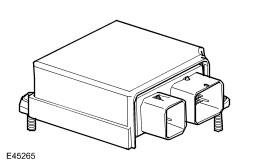
The restraints control module (RCM) is installed on the top of the transmission tunnel, in line with the B pillars, and controls operation of the supplemental restraint system (SRS). The main functions of the restraints control module (RCM) include:
- Crash detection and recording.
- Air bag and pretensioner firing.
- Self test and system monitoring, with status indication via the supplemental restraint system (SRS) warning lamp, and non volatile storage of fault information.
A safing sensor in the restraints control module (RCM) provides confirmation of an impact to verify if air bag and pretensioner activation is necessary. A roll-over sensor monitors the lateral attitude of the vehicle. Various firing strategies are employed by the restraints control module (RCM) to ensure that during an accident only the appropriate air bags and pretensioners are fired. The firing strategy used also depends on the inputs from the safety belt switches and the occupant monitoring system.
An energy reserve in the restraints control module (RCM) ensures there is always a minimum of 150 milliseconds of stored energy available if the power supply is disrupted during a crash. The stored energy is sufficient to produce firing signals for the driver air bag, the passenger air bag and the safety belt pretensioners.
When the ignition is switched on the restraints control module (RCM) performs a self test and then performs cyclical monitoring of the system. If a fault is detected the restraints control module (RCM) stores a related fault code and illuminates the supplemental restraint system (SRS) warning indicator. The faults can be retrieved by Land Rover approved diagnostic equipment. If a fault that could cause a false fire signal is detected, the restraints control module (RCM) disables the related firing circuit, and keeps it disabled during a crash event.