Torque Converter: Stator
The stator is located on the splined transmission input shaft via a freewheel clutch. The stator comprises a number of blades which are aligned in an opposite direction to those of the impeller and turbine. The main function of the stator is to redirect the returning fluid from the turbine, changing its direction to that of the impeller.
The redirected fluid from the stator is directed at the inner row of blades of the impeller, assisting the engine in turning the impeller. This sequence increases the force of the fluid emitted from the impeller and thereby increases the torque multiplication effect of the torque converter.
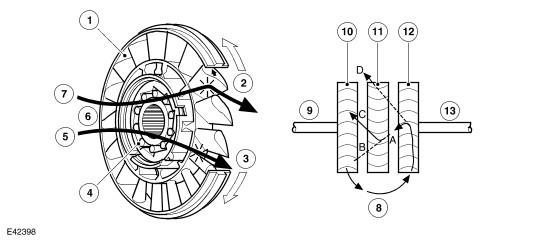
| Item Number | Description |
|---|---|
| 1 | Blades |
| 2 | Stator held - fluid flow redirected |
| 3 | Stator rotates freely |
| 4 | Roller |
| 5 | Converter at coupling speed |
| 6 | Fluid flow from turbine |
| 7 | Converter multiplying |
| 8 | Fluid flow from impeller |
| 9 | Drive from engine |
| 10 | Impeller |
| 11 | Stator |
| 12 | Turbine |
| 13 | Output to transmission |
Fluid emitted from the impeller acts on the turbine. If the turbine is rotating at a slower speed than the fluid from the impeller, the fluid will be deflected by the turbine blades in the path 'A' . The fluid is directed at and deflected by the stator blades from path 'B' to path 'C' . This ensures that the fluid is directed back to the pump in the optimum direction. In this condition the sprag clutch is engaged and the force of the fluid on the stator blades assists the engine in rotating the impeller.
As the rotational speed of the engine and therefore the turbine increases, the direction of the fluid leaving the turbine changes to path 'D' . The fluid is now directed from the turbine to the opposite side of the stator blades, rotating the stator in the opposite direction. To prevent the stator from resisting the smooth flow of the fluid from the turbine, the sprag clutch releases, allowing the stator to rotate freely on its shaft.
When the stator becomes inactive, the torque converter no longer multiplies the engine torque. When the torque converter reaches this operational condition it ceases to multiply the engine torque and acts solely as a fluid coupling, with the impeller and the turbine rotating at approximately the same speed.
The stator uses a sprag type, one way, freewheel clutch. When the stator is rotated in a clockwise direction the sprags twist and are wedged between the inner and outer races. In this condition the sprags transfer the rotation of the outer race to the inner race which rotates at the same speed.