Lock-Up Clutch Mechanism
The torque converter clutch (TCC) is hydraulically controlled by an EPRS (electronic pressure regulating solenoid), which is controlled by the transmission control module (TCM). This allows the torque converter to have three states of operation as follows:
- Fully engaged
- Controlled slip variable engagement
- Fully disengaged.
The torque converter clutch (TCC) is controlled by two hydraulic spool valves located in the valve block. These valves are actuated by pilot pressure supplied via a solenoid valve which is also located in the valve block. The solenoid valve is operated by pulse width modulation (PWM) signals from the transmission control module (TCM) to give full, partial or no lock-up of the torque converter.
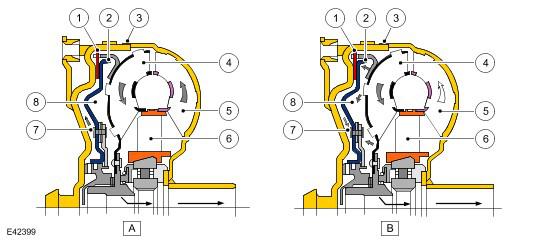
| Item Number | Description |
|---|---|
| A | Unlocked condition |
| B | Locked condition |
| 1 | Clutch plate |
| 2 | Clutch piston |
| 3 | Torque converter body |
| 4 | Turbine |
| 5 | Impeller |
| 6 | Stator |
| 7 | Piston chamber |
| 8 | Turbine chamber |
The lock-up clutch is a hydro-mechanical device which eliminates torque converter slip, improving fuel consumption. The engagement and disengagement is controlled by the transmission control module (TCM) to allow a certain amount of controlled 'slip'. This allows a small difference in the rotational speeds of the impeller and the turbine which results in improved shift quality. The lock-up clutch comprises a piston and a clutch friction plate.
In the unlocked condition, the oil pressure supplied to the piston chamber and the turbine chamber is equal. Pressurized fluid flows through a drilling in the turbine shaft and through the piston chamber to the turbine chamber. In this condition the clutch plate is held away from the torque converter body and torque converter slip is permitted.
In the locked condition, the torque converter clutch (TCC) spool valves are actuated by the EPRS. The fluid flow in the unlocked condition is reversed and the piston chamber is vented. Pressurized fluid is directed into the turbine chamber and is applied to the clutch piston. The piston moves with the pressure and pushes the clutch plate against the torque converter body. As the pressure increases, the friction between the clutch plate and the body increases, finally resulting in full lock-up of the clutch plate with the body. In this condition there is direct mechanical drive from the engine crankshaft to the transmission planetary gear train.