Electronic Pressure Regulator Solenoids
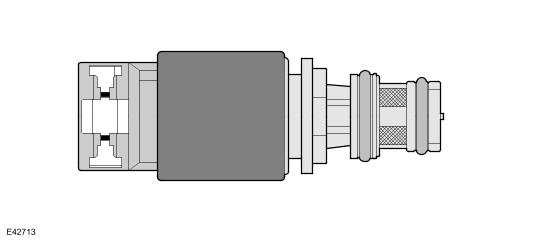
Six EPRS are located in the valve block. The solenoids are controlled by pulse width modulation (PWM) signals from the transmission control module (TCM). The solenoids convert the electrical signals into hydraulic control pressure proportional to the signal to actuate the spool valves for precise transmission operation.
The following table shows EPRS and their associated functions:
| EPRS | Function |
|---|---|
| 1 | Clutch A |
| 2 | Clutch B |
| 3 | Clutch C |
| 4 | Brake clutches D and E |
| 5 | System pressure control |
| 6 | Torque converter lock-up control |
Solenoids EPRS 1, 3 and 6 supply a lower control pressure as the signal amperage increases and can be identified by a black connector cap. The transmission control module (TCM) operates the solenoids using PWM signals. The TCM monitors engine load and clutch slip and varies the solenoid duty cycle accordingly. The solenoids have a 12 V operating voltage and a pressure range of 0 - 4.6 bar (0 - 67 lbf.in2 ).
Solenoids EPRS 2, 4 and 5 supply a higher control pressure as the signal amperage increases and can be identified by a green connector cap. The solenoids are normally open, regulating flow solenoid valves. The operates the solenoids using a pulse width modulation (PWM) earth proportional to the required increasing or decreasing clutch pressures. The solenoids have a 12 V operating voltage and a pressure range of 4.6 - 0 bar (67 - 0 lbf.in2 ).
The resistance of the solenoid coil winding for solenoid is between 26 to 30.4 ohms at 20 °C (68 °F).