Drive Clutches
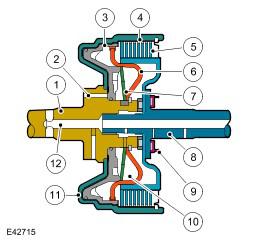
| Item Number | Description |
|---|---|
| 1 | Input shaft |
| 2 | Main pressure supply port |
| 3 | Piston |
| 4 | Cylinder - external plate carrier |
| 5 | Clutch plate assembly |
| 6 | Baffle plate |
| 7 | Diaphragm spring |
| 8 | Output shaft |
| 9 | Bearing |
| 10 | Dynamic pressure equalization chamber |
| 11 | Piston chamber |
| 12 | Lubrication channel |
There are three drive clutches and two brake clutches used in the ZF 6HP28 transmission. Each clutch comprises one or more friction plates dependent on the output controlled. A typical clutch consists of a number of steel outer plates and inner plates with friction material bonded to each face.
On 3.0L diesel models, the uprated transmission includes additional clutch plates to enable the transmission to manage the additional power output from these engines.
The clutch plates are held apart mechanically by a diaphragm spring and hydraulically by dynamic pressure. The pressure is derived from a lubrication channel which supplies fluid to the bearings etc. The fluid is passed via a drilling in the output shaft into the chamber between the baffle plate and the piston. To prevent inadvertent clutch application due to pressure build up produced by centrifugal force, the fluid in the dynamic pressure equalization chamber overcomes any pressure in the piston chamber and holds the piston off the clutch plate assembly.
When clutch application is required, main pressure from the fluid pump is applied to the piston chamber from the supply port. This main pressure overcomes the low pressure fluid present in the dynamic pressure equalization chamber. The piston moves, against the pressure applied by the diaphragm spring, and compresses the clutch plate assembly. When the main pressure falls, the diaphragm spring pushes the piston away from the clutch plate assembly, disengaging the clutch.