Four-Wheel Drive Systems: General
The DD295 transfer box is a full time, permanent four-wheel-drive unit, with 50/50 torque distribution to the front and rear driveshafts. The unit is manufactured by Magna Steyr Powertrain in Graz, Austria and supports the following features:
- Permanent four-wheel-drive with a bevel gear centre differential, providing a 50:50 torque split
- Selectable high and low range for optimum on-road and off-road performance
- Two-speed, fully synchronized 'shift-on-the-move' system allows the driver to change the range without having to stop the vehicle
- Electronically controlled multi-plate clutch providing a centre differential lock and torque biasing function to give improved traction performance and vehicle dynamic stability.
A strategy, to electronically control the centre differential multi plate clutch assembly, has been developed to provide:
- A pre-loading function, increasing locking torque with increased driving torque
- A slip controller to increase locking torque under off-road conditions and decrease locking torque for optimum comfort, e.g. parking.
The unit is located under the vehicle and is mounted on the cross-member, behind the transmission. The unit is identical for all engine derivatives.
The transfer box receives a torque input from the transmission output shaft, which is passed through the unit to two outputs for the front and rear drive shafts.
The input torque is equally distributed via a bevel gear type differential. In order to provide an optimal torque distribution to each wheel in all driving conditions, the unit is equipped with an electronically controlled locking and torque-biasing device. This device detects wheel slip via various vehicle system inputs to the transfer box control module and locks the differential accordingly. The locking torque is applied through a multi-plate clutch assembly.
A planetary gear set, located in the differential assembly, allows the driver to select high or low range whilst driving, this is known as 'shift on the move'. When in low range, the planetary gear set provides a ratio of 2.93:1, which gives the vehicle an extremely low crawl speed for off road driving and trailer towing. High range is a direct drive from the transmission output shaft and provides a 1:1 ratio.
Both the centre differential locking and biasing and the 'shift on the move' features are actuated via a DC transfer box motor, which is controlled by the transfer box control module, via a Pulse Width Modulation (PWM) signal.
Transfer Box - Sectional View
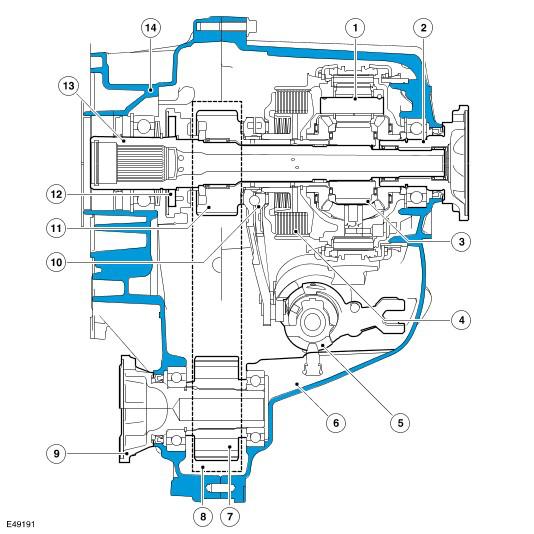
| Item Number | Description |
|---|---|
| 1 | Planetary gear set |
| 2 | Rear output flange |
| 3 | Centre differential assembly |
| 4 | Multi-plate clutch |
| 5 | Transfer box motor module |
| 6 | Rear housing assembly |
| 7 | Front output sprocket |
| 8 | Chain drive |
| 9 | Front output flange |
| 10 | Transfer box motor levers |
| 11 | Sprocket |
| 12 | Oil pump assembly |
| 13 | Input shaft |
| 14 | Front housing assembly |
Transfer Box Power Flow
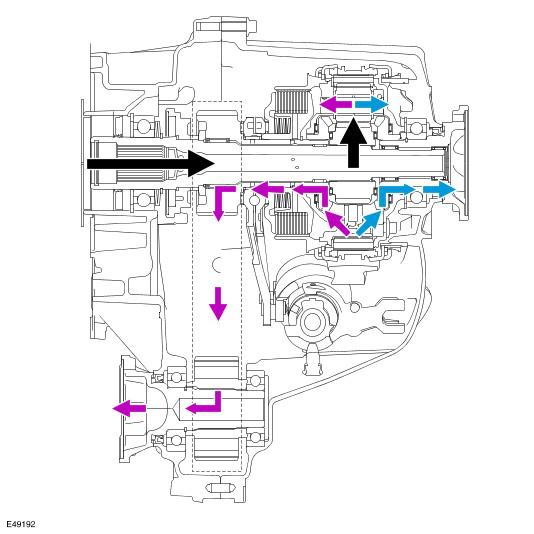
The input torque, from the transmission, is transferred to the input shaft of the transfer box and then onto the planetary sun gear and planetary pinion gears. The planetary pinion gears are held in place by the planet pinion shafts, which are connected to the differential carrier, and drive the differential pinion gears. The torque is then distributed to both the front and rear carriers, which are connected to the outputs of the transfer box. The rear carrier is connected directly to the rear output flange; the front carrier is connected to the sprocket and therefore to the chain drive, which provides the front output flange rotation.