Centre Differential Assembly: Notes
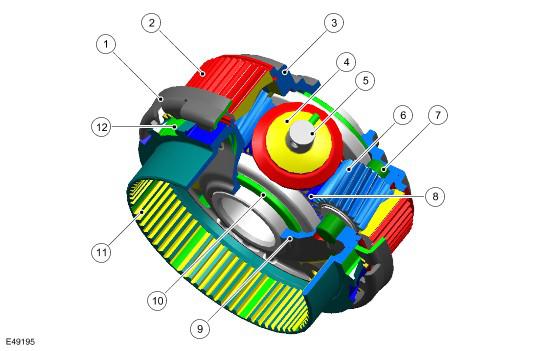
| Item Number | Description |
|---|---|
| 1 | Synchronisation cup and spring |
| 2 | Planetary ring gear |
| 3 | Differential carrier |
| 4 | Pinion gears |
| 5 | Pinion gear shafts |
| 6 | Planetary pinion gears |
| 7 | Planetary pinion gear shafts |
| 8 | Planetary sun gear |
| 9 | Differential cover |
| 10 | Differential side gears |
| 11 | Multi-plate clutch basket |
| 12 | Dogteeth |
The centre differential assembly is the primary feature of the transfer box. Torque is transmitted through the centre differential carrier and distributed to the differential gears and the front and rear output flanges. The planetary gear set, for the high/low range change function, is also an integral part of the centre differential assembly.
The assembly comprises 3 differential pinion gears (4) and shafts (5), which are equally spaced within the centre differential carrier (3). The differential shafts have a rigid connection to the differential carrier. Located between the pinion gears are 3 planetary pinion gears (6) and shafts (7). The planetary sun gear (8) and two differential side gears (10) are located in the centre line of the carrier.
The planetary ring gear (2) is supported in both directions by the differential casing and the differential cover (9). The planetary ring gear is connected to a shifting sleeve, which is engaged in either high or low range.
The multi-plate clutch basket (11), which is welded to the differential casing, supports the friction plates, the dogteeth (12) for high range engagement and the synchronisation cup and spring (1) for the 'shift-on-the-move' function.
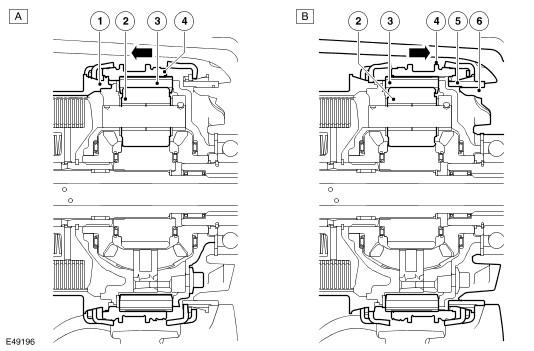
| Item Number | Description |
|---|---|
| A | High range position |
| B | Low range position |
| 1 | Dogteeth |
| 2 | Planetary pinion gears |
| 3 | Planetary ring gear |
| 4 | Shifting sleeve |
| 5 | Low range dogteeth |
| 6 | Rear carrier assembly |
When high range is engaged, the shifting sleeve (4) connects to the differential carrier via dogteeth (1). The planetary ring gear (3), via the shifting sleeve, and the planetary pinion gears (5), via the planetary shafts, are also attached to the differential carrier. The planetary gear set rotates as one unit and therefore turns the differential side gear with a 1:1 ratio.
In low range the motor moves the shifting sleeve (4) in the direction of the low range dogteeth (5). The low range dogteeth, with the synchronisation cup and spring, are fixed to the rear carrier assembly (6). When the shifting sleeve is engaged with the low range dogteeth, the planetary ring gear (3), via the shifting sleeve, is stationary and the planetary pinion gears (2), via the planetary bolts, turn the differential side gears with 2.93: 1 ratio.