Anti-Roll Bar
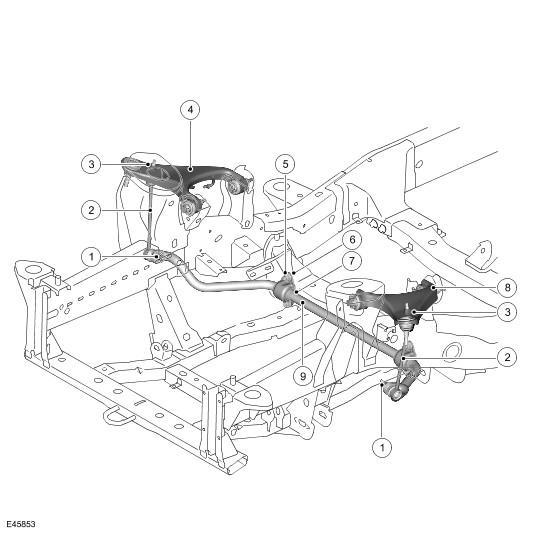
| Item Number | Description |
|---|---|
| 1 | Nut - link to anti-roll bar (2 off) |
| 2 | Link (2 off) |
| 3 | Nut - link to upper control arm (2 off) |
| 4 | RH upper control arm |
| 5 | Nut (4 off) |
| 6 | Bracket (2 off) |
| 7 | Bush (2 off) |
| 8 | LH upper control arm |
| 9 | Anti-roll bar |
The anti-roll bar is fabricated from induction hardened, solid spring steel bar. The anti-roll bar operates, via a pair of links, from their attachment to the upper control arm.
The anti-roll bar is attached to the forward face of the chassis front cross member. The anti-roll bar is attached to the cross member with two, Teflon lined bushes. Brackets, which are pressed onto the bushes, are attached to the cross member with nuts, screwed onto studs in the cross member. The anti-roll bar has crimped, 'anti-shuffle' collars pressed in position on the inside edges of the bushes. The collars prevent sideways movement of the anti-roll bar.
The ends of the anti-roll bar are attached to the upper control arms via links. This allows the anti-roll bar to move with the wheel travel providing maximum effectiveness. Each link has a ball joint at each end. The top ball joint is attached to the link, parallel with the link axis. The ball joint is located in a hole in the upper control arm and secured with a self-locking nut. The bottom ball joint is attached to the link at 90 degrees to the link axis. The ball joint is located in a hole in the end of the anti-roll bar and secured with a self-locking nut. The links are not handed and therefore can be fitted to either side of the anti-roll bar.