Lower Control Arm
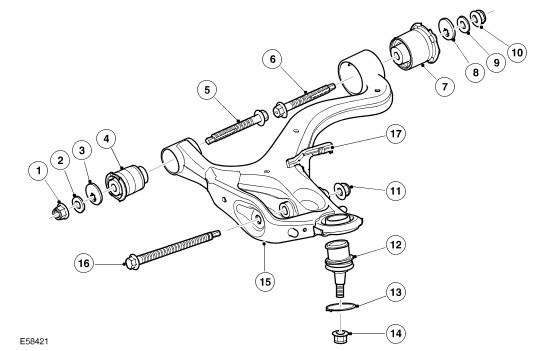
| Item Number | Description |
|---|---|
| 1 | Self locking nut |
| 2 | Flat washer |
| 3 | Cam washer |
| 4 | Bush |
| 5 | Special bolt |
| 6 | Bolt |
| 7 | Hydrobush |
| 8 | Cam washer |
| 9 | Flat washer |
| 10 | Self locking nut |
| 11 | Self locking nut - damper lower attachment |
| 12 | Ball joint |
| 13 | Circlip |
| 14 | Self locking nut |
| 15 | Lower control arm |
| 16 | Bolt - damper lower attachment |
| 17 | Jacking bracket (Vehicles with coil springs only) |
The lower control arm assembly comprises, the control arm, two bushes and a ball joint. The lower control arm is a pressed steel fabrication with a hole at its outer end to accept the ball joint.
The inner end of the arm has two fabricated bush housings which are welded to the arm pressing. A bush is pressed into each housing. The rear bush is a hydrobush which provides a progressive increase in the hardness of the bush as the deflection of the wheel increases. The bushes are located between lugs on the chassis and are secured with bolts and self-locking nuts through metal inserts in the center of the bushes. The forward bush, self-locking nut, has a cam washer located beneath it. The cam washer is located between lugs on the chassis bracket and its orientation can be adjusted to set the front camber. The rear bush, self-locking nut, also has a cam washer located beneath it. The cam washer is located between lugs on the chassis bracket and its orientation can be adjusted to set the front castor.
On vehicles fitted with coil springs only, a jacking bracket is located on the lower control arm.
A central aperture in the arm provides for the attachment of the damper module lower bush. The damper is secured with a long bolt which is positioned through holes in the arm and secured with a self-locking nut.
The ball joint is pressed into the lower control arm. The ball joint is an interference fit in the hole which prevents the ball joint from moving. A circlip is fitted to the ball joint to retain it in the hole.