Operating Modes: Notes
Using the air suspension switch, the driver is able to manually select one of four ride states:
- ON-ROAD - this height is the normal operating height of the vehicle
- OFF-ROAD - this height is higher than the on-road height and provides improved ground clearance, approach, departure and breakover angles
- ACCESS - this height is lower than the on-road height and makes entering and exiting the vehicle easier for the occupants
- CRAWL (Locked at access) - this height allows the vehicle to be driven at the access height at low speeds to provide increased roof clearance in low car parks etc.
An additional 'TRANSPORTATION' mode is also available but is only selectable using the Land Rover approved diagnostic equipment.
An additional function allows the vehicle to be raised or lowered from outside of the vehicle when the vehicle is stationary. For example, this may assist with the attachment of a trailer and is achieved using the buttons on the remote handset and the ignition switch in the off position. The remote handset can be programmed to perform a number of additional functions. Refer to Handles, Locks, Latches and Entry Systems article.
If the air suspension control module senses that the vehicle has grounded and lost traction, the control module can temporarily increase and/or redistribute the volume of air supplied to the affected air spring(s) to maximize the available traction. This is known as extended mode and will be indicated to the driver by the lamps on the air suspension switch flashing, and messages displayed in the instrument cluster message center.
If the air suspension control module senses that the vehicle is prevented from moving upwards or downwards during a height change or leveling correction, the control module will adopt a safe state and further height changes will be suspended.
If a fault is detected by the air suspension control module, the control module will reduce the system functionality dependent on the type and severity of the fault. The control module will also store a fault code which can be retrieved using the Land Rover approved diagnostic equipment. If a severe fault occurs, the control module will attempt to put the vehicle in a safe condition. A fault is relayed to the driver by the illumination of the air suspension warning indicator, the instrument cluster message center and an audible warning emitted from the instrument cluster.
If the detected fault is minor and does not affect vehicle safety, the air suspension warning indicator in the instrument cluster will illuminate in an amber color and the fault should be rectified at the earliest opportunity. If a more severe fault is detected, the warning indicator will illuminate in a red color above 31 mph (50 km/h) vehicle speed, and the vehicle should be driven with care until the fault is rectified. An audible warning is emitted by the instrument cluster sounder when the warning indicator is illuminated. The indicator will change to an amber color and the audible warning will stop when the vehicle speed is reduced.
Air Suspension Switch Mode Lamps
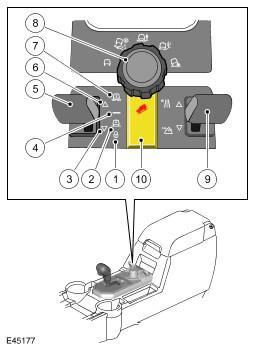
| Item Number | Description |
|---|---|
| 1 | Crawl mode lamp |
| 2 | Access mode lamp |
| 3 | Lowering lamp |
| 4 | On-road mode lamp |
| 5 | Air suspension switch |
| 6 | Raising lamp |
| 7 | Off-road mode lamp |
| 8 | Terrain Response™ rotary control |
| 9 | Transfer box range switch |
| 10 | Hill Descent Control (HDC) switch |