Air Suspension Switch
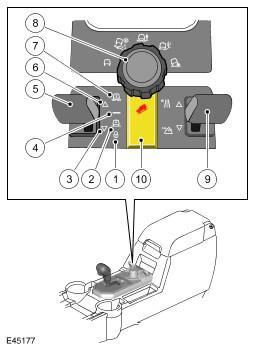
| Item Number | Description |
|---|---|
| 1 | Crawl mode lamp |
| 2 | Access mode lamp |
| 3 | Lowering lamp |
| 4 | On-road mode lamp |
| 5 | Air suspension switch |
| 6 | Raising lamp |
| 7 | Off-road mode lamp |
| 8 | Terrain Response™ rotary control |
| 9 | Transfer box range switch |
| 10 | Hill Descent Control (HDC) switch |
The air suspension control switch is located in the center console, behind the manual or automatic transmission selector lever. The switch is a three position, non-latching switch which allows selection of the following driver selectable modes:
- Off-road mode
- On-road mode
- Access mode
- Crawl (locked at access) mode.
The air suspension switch can be moved forwards or backwards from its central position. The switch is non-latching and returns to the central position when released. The switch completes an earth path to the air suspension control module when operated. This earth path is completed on separate wires for the raise and lower switch positions, allowing the control module to determine which selection the driver has made.
The switch has six symbols which illuminate to show the current selected height and the direction of movement. The raise and lower symbols will flash and a warning tone will be emitted from the instrument cluster sounder when a requested height change is not allowed, i.e. vehicle speed too fast.
A flashing symbol indicates that the air suspension system is in a waiting state or that the system will override the driver's selection because the speed threshold is too high.
The driver can also ignore the system's warnings signals and allow the height to change automatically. For example, increasing the vehicle speed to more than 25 mph (40 km/h) will cause the control module to automatically change the ride height from off-road mode to on-road mode.