Charcoal Canister
Charcoal Canister - All Except NAS
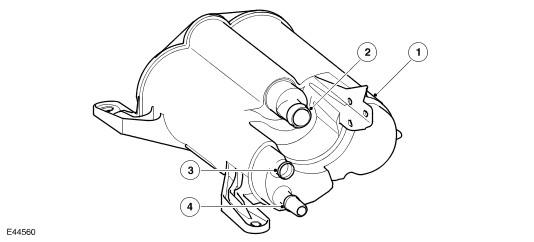
| Item Number | Description |
|---|---|
| 1 | Charcoal canister |
| 2 | Atmospheric vent pipe connection |
| 3 | Fuel tank vent pipe connection |
| 4 | Purge valve pipe connection |
Charcoal Canister - NAS
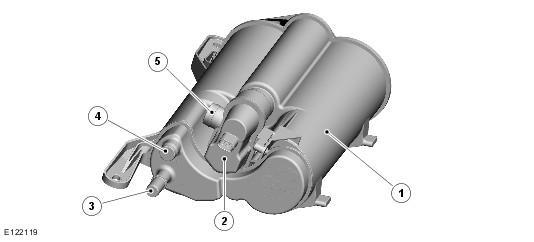
| Item Number | Description |
|---|---|
| 1 | Charcoal canister |
| 2 | DMTL pump |
| 3 | Purge valve pipe connection |
| 4 | Fuel tank vent pipe connection |
| 5 | Atmospheric vent pipe connection |
The charcoal canister is located in a central position, forward of the spare wheel. It is attached at the rear with two bolts which screw into the spare wheel carrier. At the front, the canister has two lugs which locate in the electronic parking brake (EPB) module support bracket.
The canister on all except NAS vehicles has a capacity of 1400 cc (85.4 in3 ).
The canister on NAS vehicles has a capacity of 3000 cc (183 in3 ).
The canister has three connections for attachment of the pipes from the atmospheric vent, the purge valve and the tank vent. On NAS vehicles, the DMTL pump is installed between the atmospheric vent connection and the atmospheric vent pipe.
The canister contains a bed of activated charcoal or carbon. The charcoal is produced using special manufacturing techniques to treat the charcoal with oxygen. The oxygen treatment opens up millions of pores between the carbon atoms resulting in a highly porous charcoal with a very large effective surface area which is capable of absorbing large quantities of fuel vapor. Once treated the charcoal is known as 'activated' carbon or charcoal. The charcoal canister on NAS vehicles uses a higher grade charcoal to meet the stricter emissions regulations.
A filter on the atmospheric vent prevents dust being drawn into the system. The filter is located by the fuel filler cap.