Fuel Pump Driver Module (FPDM)
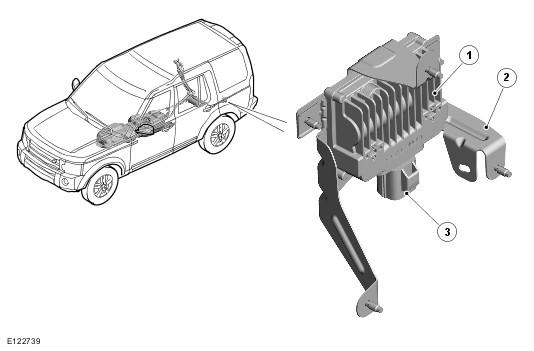
| Item Number | Description |
|---|---|
| 1 | Fuel Pump Driver Module (FPDM) |
| 2 | Mounting bracket |
The FPDM is located in the LH side of the luggage compartment, above the LH wheel arch, behind the trim panel. The FPDM is located on a bracket and secured with 2 bolts and nuts.
The fuel pump operation is regulated by the FPDM which is controlled by the Engine Control Module (ECM). The FPDM regulates the flow and pressure supplied by controlling the operation of the fuel pump using a PWM output.
The FPDM is powered by a supply from the fuel pump relay in the Engine Junction Box (EJB). The fuel pump relay is energized on opening the driver's door or when power mode 9 engine crank is initiated using the stop/start button. The FPDM supplies power to the fuel pump, and adjusts the power to control the speed of the fuel pump and thus the pressure and flow in the fuel delivery line.
A Pulse Width Modulation (PWM) signal from the ECM tells the FPDM the required speed for the fuel pump. The on time of the PWM signal represents half the fuel pump speed, e.g. if the PWM signal has an on time of 50%, the FPDM drives the pump at 100%.
The FPDM will only energize the fuel pump if it receives a valid PWM signal, with an on time of between 4% and 50%. To switch the fuel pump off, the ECM transmits a PWM signal with an on time of 75%.
The output pressure from the fuel pump will change with changes of engine demand and fuel temperature. The ECM monitors the input from the Low Pressure (LP) fuel sensor and the fuel rail pressure sensor and adjusts the speed of the fuel pump as necessary to maintain a nominal output pressure of 450 kPa (4.5 bar; 65.3 lbf/in.2 ), except during engine start-up. At engine start-up the target pressure for the fuel delivery line is 630 kPa (6.3 bar; 91.4 lbf/in.2 ).
If the Supplemental Restraint System (SRS) outputs a crash signal on the high speed Controller Area Network (CAN) bus, the ECM de-energizes the fuel pump relay to prevent any further fuel being pumped to the engine.
If the ECM does not detect pressure in the fuel delivery line, it stops, or refuses to start the engine and stores the appropriate Diagnostic Trouble Code (DTC).
The ECM receives a monitoring signal from the FPDM. Any DTC's produced by the FPDM are stored by the ECM.
DTC's can be retrieved from the ECM using an approved Land Rover diagnostic system. The FPDM itself cannot be interrogated by the approved Land Rover diagnostic system.